The day children ask about manual lawn care
22 January 2026
In a few years, maybe sooner, a child will ask their parent: “Did you really use to cut the grass yourself?” The question will land like “Did you really wash dishes by hand?” A small piece of history, no longer imagined as necessary. And when that moment arrives – when the question feels almost quaint – Husqvarna will have already rewritten the story of how that world came to be.
Husqvarna Group is a 336-year-old Swedish company that has spent the last two decades doing something rare: transforming how entire industries work. The company is a global leader across multiple categories – and what ties them together is something deeper than products. It’s a never-ending passion for innovation.
The millions of robotic lawn mowers now installed worldwide speak for themselves, but they only tell one part of the story. Husqvarna Group creates chainsaws engineered for precision. Gardening tools that merge durability with thoughtful design. Construction equipment that’s redefining what’s possible on job sites across Europe. What connects them all is that they are a result of the same core principle at Husqvarna Group: making work smarter, faster, and more sustainable.
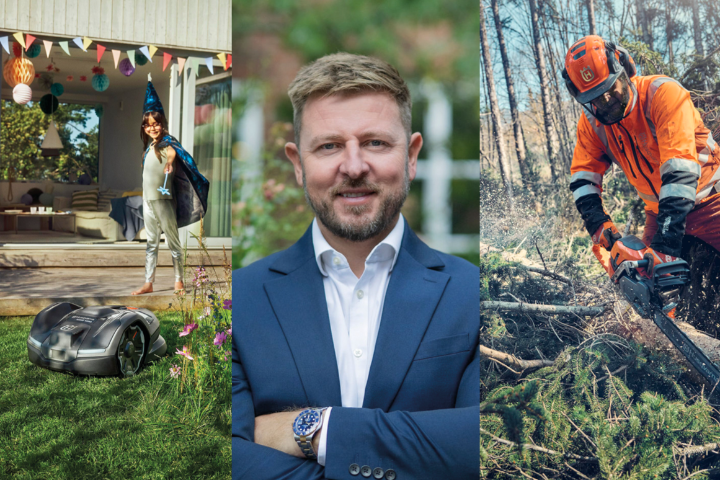
At the centre of it all is Glen Instone, the company’s newly appointed Group CEO and the first non-Swedish person to take on the role. But what really makes Glen stand out isn’t just this historic milestone, it’s the clarity he brings to what comes next.
Speaking with Glen, his energy is immediate. There’s a directness to how he thinks, an infectious confidence about what’s possible. He doesn’t rely on corporate language. Instead, he frames Husqvarna’s mission in terms that feel almost refreshingly simple: “We are a product company at heart. There’s no doubt about that. Husqvarna is a product centric company, and we like to make new products and solutions. And we’ve got a lot of passionate engineers in this company working on existing and new offerings.”
But this isn’t nostalgia for the past. It’s clarity about the future. “At our heart is a 336-year-old company,” Glen explains. “What we have done in that time is constantly reinvent ourselves. We’ve gone from making muskets to sewing machines to bicycles to motorcycles to chainsaws.” And now, to leading the automation of industries most people assumed would never change.
The robotic revolution that rewrites how we think
One moment stands out in Glen’s 23-year journey at Husqvarna: four and a half million robotic lawnmowers. That’s not a statistic. That’s a quiet revolution.
When Glen joined Husqvarna in 2002, the company was already tinkering with a product invented back in 1995. “We didn’t have the best success in the early years,” he recalls. That same year, Husqvarna was producing just 4,000 robotic mowers – and production moved from Sweden to the UK. Not exactly the stuff of a business legend.
But Glen saw something different. He watched the technology improve. He watched the market shift. He watched consumers start to imagine a different kind of lawn care. Now, more than two decades later, Husqvarna has put 4.5 million robotic mowers into homes and gardens across the world.
The impact is almost philosophical. “Maybe I can liken this to a sort of dishwasher moment,” Glen says. “Our children really would look at us and say, ‘did you use to wash the dishes yourself?’ And I think one day we’re going to have that same saying, ‘did you really use to cut the grass yourself?’”
It’s the kind of observation that feels humble until you realise what it means: Husqvarna didn’t just make a better machine. It rewrote the rules of an entire industry. And it did so by sticking to something that feels almost out of fashion – patient innovation.
Leadership that trusts people to be better than you
Ask Glen about his leadership style, and he gives you three words: trust, empowerment, and simplicity. Not because they sound good. Because he’s seen it in action.
“I didn’t just pick up this with three buzzwords,” he insists. “It’s more that I’ve watched how different people lead and this is what I think is successful.”
He’s had two pieces of advice that stuck. The first came from a previous CEO: “Plant the feet firmly where they are, meaning do a good job here and now and the next position will find you.” Simple. It freed him from the worry of climbing, and secondly: “The light shines brightest when reflecting off others around you.” In other words, surround yourself with people smarter than you. “Most of the time I should be the dumbest guy in the room,” he says with genuine comfort. “That’s how it should be.”
This isn’t false humility from a CEO who’s just reached the top. It’s the foundation of how he’s built his career. When facing challenges – and in 23 years at Husqvarna, there have been plenty – Glen relies on two things: staying alert and staying connected to customers. “The business cases you wrote three years ago or 12 months ago – things change, the world around you changes. You’ve got to change with the environment.”
He argues that internally focused organisations fail. But companies obsessed with two things – understanding customers and building strong teams – are already halfway to success. “If you really understand your customer group and you’ve got a good team around you, I think you’re a big chunk of the way there.”
A company that constantly reinvents itself
What keeps a company alive for more than three centuries? For Glen it’s clear: innovation. “We’ve got a lot of passionate engineers in this company working on existing and new offerings. That innovation drumbeat is what’s kept us going.”
But innovation without purpose becomes distraction. The company’s Strategy 2030, launched in December, focuses on something Glen calls “where to play and how to win.” It sounds simple, which is exactly the point.
The strategy rests on two differentiators. First, excellence in aftermarket service. “Being the best service provider possible,” Glen explains. It means best-in-class support, replacement parts that are available, and a customer experience that extends far beyond the initial sale. Second, brand power. “We’ve got two super brands – Husqvarna Group and Gardena. We’ve got to shout more about them.”
But strategy without execution is simply an aspiration. So, the company is getting rigorous about cost competitiveness, enabling investment in innovation, brands, and those aftermarket services. “Focus is key,” Glen insists. “A lot of companies fail because they try and do too many things. I think it’s better to do a few things well.”
He brings this philosophy to everything – even how to remember a strategy. “We talk in threes because maybe we can remember things in threes or we can execute things in threes. When you start making that list five things, then it starts to dilute what you’re really trying to do.”
Swedish roots, global reach
The Swedish values that shaped Husqvarna are embedded in how Glen leads. Innovation and engineering excellence aren’t just Husqvarna traits – they’re hallmarks of Swedish industry. But there’s something else: a commitment to balance. People. Planet. Profitability. “The three have got to play in harmony,” Glen says. “It’s hard to say one’s more important, but I think they’ve all got to play together.”
This isn’t just corporate philosophy. It’s reflected in partnerships like Husqvarna’s sponsorship of the AIG Women’s Open, where in 2025 robotic mowers maintained the fairways at one of golf’s major championships for the first time ever. Or Liverpool FC, where the values between organisation and brand aligned perfectly.
These aren’t vanity projects. They’re proof points. Husqvarna is building a different kind of company – one that innovates with purpose, leads with trust, and believes that the future isn’t just about making better products. It’s about making them better for everyone.
For Glen, that’s not a strategy document. That’s just how you lead.
4 quick questions with Glen
A book Glen thinks that everyone should read.
“Act like a leader, think like a leader by Herminia Ibarra.”
A Swedish tradition he has truly embraced.
“Midsummer! Celebrated at the end of June, around the summer solstice and longest day of the year. A great opportunity to spend time with family and friends.”
A hidden talent of his.
“Making spaghetti bolognese!”
What is his favourite Husqvarna tool and why?
“Favourite is the Automower. Why would anyone cut their own lawn, when they can sit back and watch the Husqvarna Automower in action with perfect results!?“