Leaders unite at London Climate Action Week to scale clean construction in cities
29 June 2026
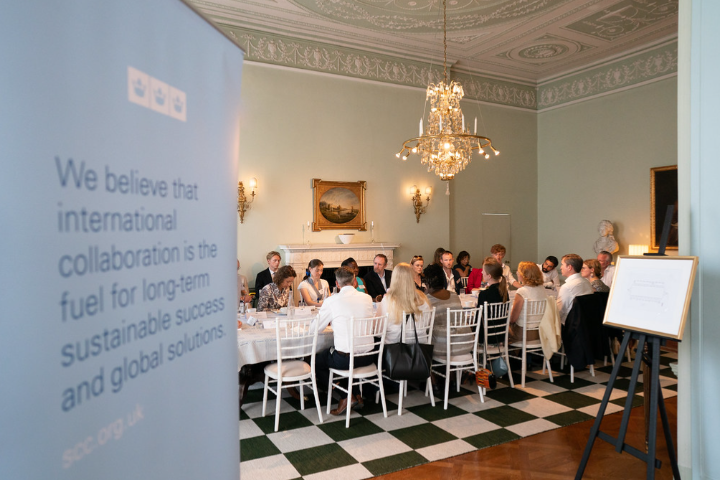
At this year’s London Climate Action Week (LCAW), Volvo Construction Equipment (Volvo CE), the Swedish Chamber of Commerce for the UK (SCC UK) and the Embassy of Sweden in London convened a multinational group of policymakers, industry leaders, air quality advocates and researchers to address a critical next step for cities: scaling zero-emission construction to improve urban air quality and public health.
- Leaders from policy, industry and civil society convened to discuss how to accelerate clean construction at scale
- Diesel compact construction machines remain a major pollution source due to a regulatory gap, emitting high levels of harmful NOx and PM
- Uptake of zero-emission solutions is too slow and must be accelerated through policy, procurement, and partnership
Building on last year’s discussion, which focused on whether clean construction solutions could work in practice, this year’s roundtable marked a clear turning point. The consensus among participants was unequivocal: the technology is proven - the challenge now is delivering it at scale.
A regulatory gap with major health impacts
A central focus of the discussion was the continued impact of diesel-powered compact construction equipment, an overlooked source of urban air pollution. While covered by existing standards, weaker requirements for smaller engines mean these machines are not subject to the same stringent emission controls as larger equipment or on-road vehicles such as trucks and cars. In practice, this creates a gap in current air quality policy, allowing high-emitting machines to continue operating widely in cities.
These compact machines emit disproportionately high levels of nitrogen oxides (NOx) and particulate matter (PM), pollutants linked to serious health impacts including respiratory and cardiovascular disease. Because they operate at street level, often close to homes, schools and workplaces, their impact on public health is amplified.
In London alone, an estimated 5,000 diesel compact construction machines emit pollution equivalent to more than 100,000 diesel cars. Across the UK, air pollution continues to exceed health-based standards, with an estimated 94% of people exposed to levels significantly above World Health Organization (WHO) guidelines, highlighting the scale of the ongoing public health challenge.
For campaigners and affected communities, the urgency is clear. Rosamund Adoo-Kissi-Debrah CBE, Founder and Director of Ella Roberta Foundation, said: “Air pollution is a public health crisis that still isn’t receiving the attention it deserves. This is not just an environmental issue – it is about people’s health and lives being cut short. While much focus is placed on transport, pollution from construction remains an under recognised source that must be urgently addressed. The shift to emission free solutions is too slow, and faster progress requires both clear policy direction and greater public awareness. That is why proposals like Ella’s Law are so critical to recognise clean air as a fundamental right and turn awareness into enforceable action.”

From proof of concept to scale
Electric construction equipment is already in use in pioneering cities worldwide. In central London, a 12-week trial with Transport for London (TfL), FM Conway and Volvo CE showed that electric machines can replace diesel without compromising performance, eliminating harmful tailpipe emissions and reducing noise. Since then, more sites in London have adopted zero-emission machines, supported by mobile charging.
However, progress remains too slow. While early deployments show what is possible, they fall short of the pace and scale needed to improve urban air quality. The roundtable made clear that system-wide transformation is now required, with coordinated action across policymakers, clients, contractors, manufacturers, and infrastructure providers.
Karin Svensson, Head of Sustainability at Volvo Group, said: “Zero emission construction is a clear opportunity to cut emissions and improve urban air quality without sacrificing performance. The technology exists – now we need the market conditions and collaboration to scale it.”

Lessons from leading markets such as Norway and the Netherlands show that a combination of policy, procurement and incentives can rapidly accelerate adoption. Scaling this progress will require closing policy gaps, creating demand through procurement, supporting investment and uptake, and delivering the infrastructure and energy systems needed for reliable deployment. Together, these approaches offer a clear blueprint for cities to improve air quality while supporting innovation and growth.
Fredrik Warneryd, CEO of SCC UK, says: “SCC UK's role is to bring together the people and ideas needed to accelerate solutions to today's most pressing challenges. Working with the Embassy of Sweden and Volvo CE, we are demonstrating how Swedish innovation can help cities move from pilots to large-scale impact and deliver cleaner air for their communities."
London has already demonstrated global leadership in reducing emissions from road transport. The roundtable concluded that construction is the next frontier – one where decisive action can deliver immediate benefits for air quality and public health.