'If we see a spade, we call it a spade'
17 June 2026
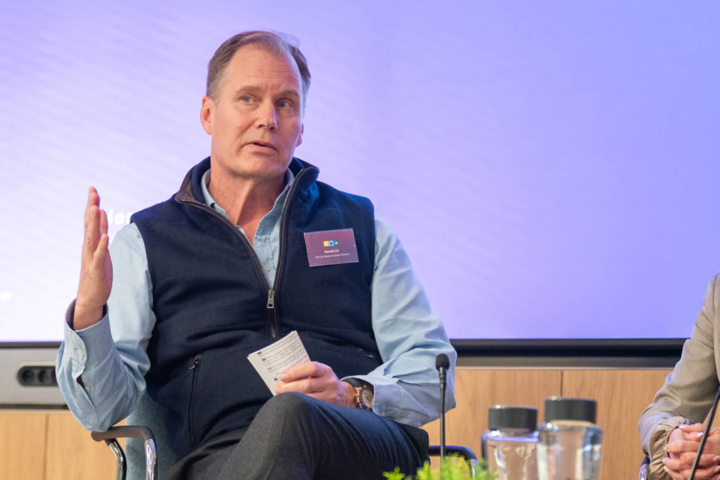
Stirling Square Capital Partners has become one of the leading pan-European investors helping Swedish mid-market companies scale onto the European stage, pairing London-based capital and networks with a long-term commitment to Nordic strengths. We spoke to Henrik Lif, Managing Partner at Stirling Square, about how this model plays out in practice.
From Stockholm to London: A Swedish dealmaker’s journey
Henrik spent most of his career in Swedish private equity before joining Stirling Square in 2017. He describes the Swedish private equity environment as rather homogeneous, with colleagues in the industry often thinking in similar ways and having been shaped by the same universities and early career steps.
Today, his London base places him in a setting that feels quite different. Stirling Square brings together 14 nationalities and 11 languages in one office, and as Henrik puts it, “We have such diverse backgrounds, and sometimes we don’t understand the nuances of each other’s cultures.” That diversity shapes the way investments are made: “It’s actually not as easy as it is in the Nordics to get something through the investment committee. It’s a higher threshold and you get questions that you never get in a more homogeneous environment.”
This has created a quite distinct and direct culture at Stirling Square. “If we see a spade, we call it a spade.” As he adds with a smile, “I am famous for that. I think I was probably too direct for the Swedish community.” His own cross-border move, from Stockholm to London, mirrors what he now helps portfolio companies do – step out of the comfort of their home markets and learn to operate in a more complex, international environment without losing their clarity or edge.
Backing local leaders to go global
Stirling Square is a pan-European private equity fund in the lower mid-market. From day one, the firm was set up with a wider European lens rather than as a local fund that later expanded. When the company was set up in 2002, they initially focused largely on investments in industrial companies.
Over time, its investment focus has shifted, as Henrik explains, “In the last 8-9 years since I’ve been around, our investments have skewed more into business services and tech. We could occasionally do an industrial deal as well, but these days I think there will always be a tech element to it.”
Today, Stirling Square backs mid-sized, local or regional champions, usually valued between €100 and €500 million, whose management teams have the ambition to expand beyond their home markets. The firm’s differentiator is not just capital. It is a repeatable model of taking local leaders and giving them the tools, networks, and acquisitions to become international platforms.
The Swedish edge in European deals
Within that European canvas, Sweden has become one of Stirling Square’s key markets. Structurally, the Nordic home markets are small. “Swedish companies typically need to expand outside of their home markets earlier in their life compared to in France, Italy, or here in the UK,” Henrik notes. That naturally creates management teams who are used to thinking beyond their own borders – a close match with Stirling Square’s international focus.
However, it is not only about size. Henrik describes the ease of doing business in the Nordics as a result of “a very well-organised corporate environment with a high trust and transparency index”, and the fact that English is widely spoken in Swedish management teams further reduces friction in cross-border work.
For investors and partners, this mix – early international ambition, strong governance and transparency, and ease of communication – makes Swedish firms particularly attractive candidates for the kind of international growth journeys that Stirling Square specialises in.
A global industry still stuck on paper
Two of Stirling Square’s recent Swedish investments sit in construction tech, a sector that, as Henrik puts it, is “one of the industries which has had the slowest adaptation of digital solutions.” Therefore offers a long runway for value creation, with both companies providing digital services that make construction projects more efficient and compliant across an expanding international footprint.
Henrik’s favourite illustration of how far the industry still has to go comes from a visit to a construction site in New York. “You had a multi billion dollar project, but the site manager was still tracking who was on site with a clipboard and a ballpoint pen,” he recalls. For him, that moment captured both the risk and the opportunity: “If you can’t even say who’s on site, you can’t manage safety, productivity, or costs properly.”
A playbook for growth
Stirling Square’s investments typically follows the same playbook: back a local champion, then accelerate its growth through international expansion, add-on acquisitions, and a broader suite of services. That doesn’t just create a larger geographic footprint; it also builds more diversified, resilient businesses. As these companies add software and services on top of their core offerings, a greater share of their revenue becomes recurring, which is exactly why Stirling Square looks for business models that can shift towards subscription and service income rather than relying on one-off industrial sales.
Preparing mid market champions for tomorrow
For Henrik, future-proofing is not a buzzword but a set of concrete priorities. When asked how Stirling Square is future-proofing its portfolio, he points to two pillars: “We focus on internationalisation and digitalisation.”
On the digital side, Stirling Square has a dedicated head of digitalisation who works with around 20 external consultants to support portfolio companies. “Typically, we help them recruit a CTO and build a proper technology function,” Henrik explains. “Most companies in our size bracket don’t have these capabilities and resources in-house, so they welcome the help rather than feeling threatened by it.”
Sustainability is treated with similar seriousness. “We develop individual sustainability programmes for each and every portfolio company,” he says, underlining that generic checklists are no longer enough. Together, digitalisation and sustainability form a focused agenda that keeps businesses relevant without overwhelming management with endless initiatives.
A partnership model of support
Underpinning all of Stirling Squares investments is a clear partnership model. “They are still running the business, we are here to support,” Henrik emphasises. As a result, Stirling Square avoids the trend of parachuting in operating partners: “If the team is not right, we change the team – we don’t try to run the business from the outside.”
Similarly, supporting the Swedish Chamber of Commerce for the UK is a natural extension of that partnership mindset. Being a Patron of the SCC UK means showing up, contributing, and building long-term relationships in a community they believe in.
In many ways, that mirrors the role Stirling Square seeks to play for its portfolio companies: a committed, quietly ambitious partner helping Nordic champions step confidently onto a wider European stage.