SKF: From industrial icon to tech-driven innovator
23 July 2026
SKF was founded in Gothenburg in 1907. For most of its life, SKF has been the kind of company that keeps other companies running – manufacturing bearings, reducing friction, preventing machinery from grinding to a halt. Essential, unglamorous, invisible. But in 2026, it is something else entirely: a data company, an energy company, a sustainability company, with a startup spirit embedded inside more than a century of engineering heritage. And it has lessons for every organisation trying to stay relevant in a world that will not stand still.
"Keep the world turning smoothly"
Ask Ian Peverill, SKF's UK lead, what the company actually does, and the answer is disarmingly simple. "SKF's ambition is to help keep the world turning smoothly," he says. "In practical terms, that means we solve problems related to friction, wear and energy loss in machinery, enabling customers to operate more efficiently, reliably and sustainably – whether in factories, transport or energy production."
That framing matters. Because the problem SKF is solving is enormous. Around 20% of all global energy is lost to friction. That is not a niche engineering challenge – it is a global efficiency crisis, with direct implications for cost, competitiveness and climate. The companies that find smarter ways to reduce that waste are not just buying better bearings; they are fundamentally changing how they operate.
Where the startup energy lives
Mention the phrase "startup energy" to most people and they picture a neon-lit office in east London, a pitch deck, and a cold brew coffee machine. SKF is a rather different proposition. Yet Ian is clear that the mindset is genuinely there. "SKF's startup energy really shines in our drive towards digital transformation and sustainable solutions," he says. "Whether it's developing smart sensor technology or exploring new ways for our customers to optimise energy usage, there's a genuine passion for innovation across the business."
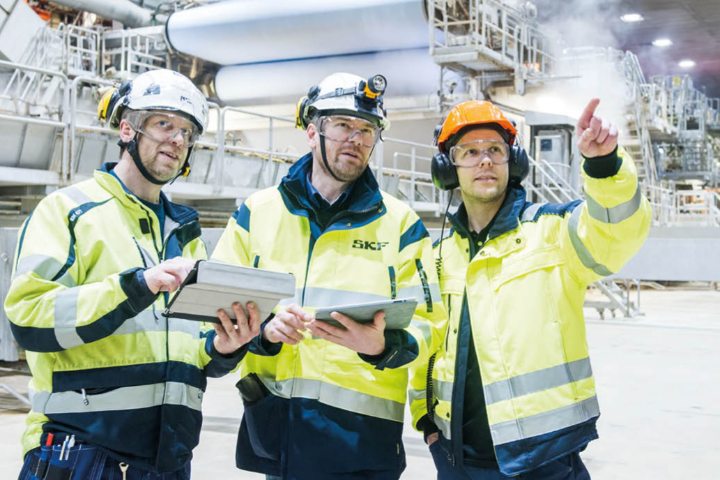
That passion is not performative. It shows up in SKF's products, its customer relationships and – increasingly – in how its factories operate. Technology is reshaping all three, but Ian identifies the biggest shifts as coming in customer collaboration and manufacturing. "Digital tools, sensors and AI-driven analytics allow us to offer predictive maintenance and tailor-made solutions, creating more collaborative relationships and adding real value beyond the product itself," he explains. Real-time data, automation and predictive maintenance are now embedded in SKF's own production lines too.
The result is a company whose value proposition has fundamentally shifted. It is no longer just about the component. It is about the insight that comes with it.
A project that shows it in practice
One recent UK project makes this concrete. Working with a large manufacturing facility in the heavy industries sector, SKF upgraded bearings and installed a monitoring system to generate real-time data on equipment performance. The outcome was a measurable reduction in energy consumption and emissions, alongside improved reliability. Not a minor gain on the margins – a meaningful operational shift, delivered through the combination of physical engineering and digital intelligence.This is what modern industrial partnership looks like. The bearing is almost beside the point. The data is the product.
Two countries, one culture
Part of what makes SKF's evolution distinctive is the cultural mix that underpins it. As a Swedish company with a strong British operation, SKF draws on what Ian describes as a productive collision of values. "The Swedish–British mix is a strong part of our identity," he says, "combining Swedish openness and focus on sustainability with British pragmatism and entrepreneurial spirit. This blend encourages creative problem-solving, transparent communication and a willingness to try new approaches."
In practice, this means a culture that is both principled and pragmatic. Long-term sustainability thinking – deeply ingrained in Swedish business culture – sits alongside a British instinct for getting things done. Together, they produce an organisation willing to invest in change and capable of delivering it.
The lesson for every organisation
The hidden opportunity in what SKF has done is not technological. It is a mindset shift. When asked what he wishes more smaller companies understood, Ian does not talk about sensors or software. He talks about values: "Focusing relentlessly on reliability, energy efficiency, and lifecycle value early – not just speed to market or lowest cost."
That is the harder, less glamorous work. And it is relevant far beyond manufacturing. In any organisation – whether it makes bearings or runs a marketing team — the temptation is to chase speed and cut cost. The organisations that endure tend to make a different bet: on quality, on longevity, and on the willingness to build for the long term.
SKF has been doing it for 119 years. The technology has changed. The principle has not.